
About Marc
My name is Marc Roman. I am a Licensed Marriage and Family Therapist (LMFT #97320) in California with twenty years of clinical experience; nine years licensed. I have worked with clients with a wide range of concerns including but not limited to anxiety, depression, communication issues, mood disorders, grief and loss, life transitions and family/relationship issues. I graduated from the California Institute of Integral Studies in with an MFT degree and have worked in a variety of clinical settings including locked inpatient units and outpatient community based mental health facilities as well as residential treatments homes. I am a solution-focused therapist with a person-centered approach. I strongly believe in the resiliency of human beings and know that you already have the answers deep inside of you. My task as your therapist is to bring out these answers in order to help you live the life you want and deserve.
Tremendous credit for ‘My Talking Cure’ is provided here to Anna O (a pseudonym for Bertha Pappenheim,) patient of physician Josef Breuer, colleague and friend of Sigmund Freud. Between 1880 and 1882 Anna O coined the term ‘talking cure’ to refer to her own verbal therapy that helped relieve her symptoms by allowing her to recall and express painful memories.
About My Talking Cure


My career in the mental health field began in the winter of 1989 when I accepted a position as a mental health worker at what was then called Hall-Brooke Foundation, located in Westport, Connecticut. Founded in 1898 by head physician Dr. David McFarland and named McFarland’s Sanitarium, the facility has undergone several name changes. The sanitarium was later re-named Hall-Brooke Sanitarium in 1964 and by 1966 became Hall-Brooke Foundation, a nonprofit organization. Today it’s referred to as St. Vincent’s Medical Center Behavioral Health Inpatient Services.
Here is my account of that experience in my position as a mental health worker.
Upon Entry
Several expansive wooden stairs, blue-ish gray in color led up to the large entry porch, it being supported by its square posts situated just outside the main front door of the building. One needed to pass through a screen door before entering the main entryway. Passing through this screen door led one to a pair of double doors leading into the central parlor and waiting area.
Admitting
The Admitting Office was directly on the left; not too large of a room, just large enough for a desk and chair for a staff person, the future patient and an extra chair or two for family members accompanying him or her. This was the first stop for all patients being admitted into Hall-Brooke whether hospitalization was voluntary or involuntary in nature. It was here that the initial intake was conducted by the Psych OD (Psychiatrist On Duty) and by the Charge Nurse.
Operator
Opposite the Admitting Room to its right was the hospital’s phone operator’s room. This very small space had a dual purpose. I recall this room being scarcely large enough for the operator, let alone her telephone switchboard and a small refrigerator where urine specimens were kept for daily pickup. Storing the specimens here was preferred to keeping them on the unit where they were drawn. The reason being, the local lab technician from our partner medical facility, Norwalk Hospital could easily stop in to Hall-Brooke on its first floor and gather up all the specimens in one fell swoop.
Codes
Despite her small confines, the operator actually held an important position among the personnel as far as I was concerned. It was the operator who nursing staff would notify in times of emergency. At Hall-Brooke, emergencies of various kinds often took place, each with their corresponding color coded service announcement made by the operator throughout the facility. For example, “Attention, Code Yellow, Main Two North!” would be called out, not once but twice indicating that a patient was “eloping” from the Main Building, North Wing. Although Code Blue was intended for personal health emergencies such as choking or difficulty breathing, and Code Red meant “fire,” it was Code Orange that concerned me the most. Whenever this code was called, I never knew what exactly I was in for when I responded. Code Orange was called when a patient was out of control and required physical restraint, a task that was often challenging for all involved. Not everyone on staff responded to emergencies. Some staff remained on the unit while others left to assist the staff of the unit requiring behavioral intervention. Mental health workers such as myself would always respond despite what we might be doing at the time of “the code.”
Outside of the operator’s room sat a sofa intended for people who were waiting to be seen by a physician. Behind the wall of where the sofa was situated was the On-Call Nursing Director’s Office. It was used primarily after business hours, on weekends and during holidays. The weekday Nursing Director’s Office was located on the second floor.
Examination Room
Outside of Admitting was the Examination Room. A few cushioned chairs were situated outside this room opposite the sofa. Unread magazines and local newspapers could be found on a table between the chairs, usually occupied by anxious family members visiting relatives or by bored patients who had the behavioral acuity to roam the hospital unattended by clinical attendants. The Examination Room was the second stop any patient made while staying at the hospital.
All patients were given a full examination and neurological assessment by a physician following their intake and before being placed on one of four units of care.
Dining
The door leading to the staff dining room was immediately outside of Main I North. The dining room itself was quite small, painted in “institutional white” and just large enough for five or so tables, each with six to eight chairs. As the name implies, staff ate in this room, while the patients were assigned to the patient dining room nearer to Main I South. Staff usually sat among other staff of their pay grade and expertise. Nurses sat among nurses, physicians among physicians and so on. The only thing that separated the staff dining room from the patient dining room was a small room known as the butler. It was used by kitchen and dining room staff. These quarters contained a stove where soup or oatmeal was kept heated depending on the meal being served. This area was also used to store dirty plates and glasses before being transported by dumbwaiter to the main kitchen below.
Both dining rooms were lined of linoleum flooring and were dimly lit except for the natural light that shined into their rectangular windows that overlooked a patch of evergreen trees. In addition to its tables and chairs, the staff dining room also contained industrial sized urns filled with coffee and hot water that were available for staff, patients and visitors alike. The patient dining room was similar in appearance only it was located immediately outside Main I South. It contained a few rectangular tables and two larger round tables and chairs. The view from the patient dining room overlooked the staff parking lot that ran along the side of the building. Unique to the patient dining room however, was a wall separating it from the butler’s room by a large window through which meals were passed.
The Basement
Underneath the grand central staircase on the first floor and on either side, were more stairs leading downstairs to the basement. Psychology Interns and Externs as well as well psychiatrists kept their offices here. There was also a room across from the psychiatrists’ offices that was used by Main I nursing staff for inter-shift meetings. Similar to other homes of the late 1800’s, there were rooms behind rooms and spaces that were large enough to be walk in closets but too small to be used as living quarters. As one might imagine, the hospital laundry facilities were located down here in the basement.
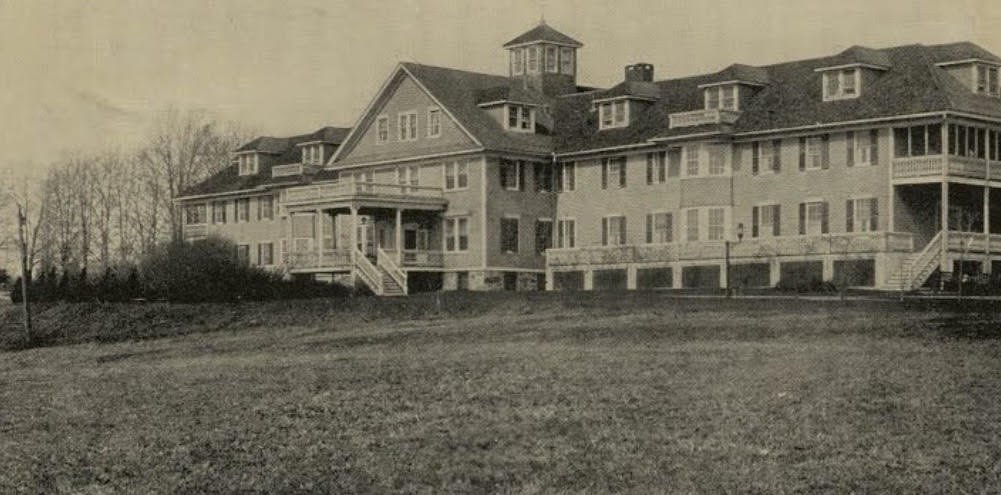
Dr. McFarland’s Asylum circa 1898
A few washers and dryers were usually sufficient to handle the laundry of the approximately 26 patients that lived in the Main Building at any one time. Patients or staff were responsible for tending to patient laundry. The laundry room was spooky to say the least. It was a small space draped in electrical wires across its low ceiling. There were as many cobwebs as there were wires and was lit by a single light bulb. As a mental health worker, it seemed that the only time available to assist patients with their laundry was during evening hours, for the day time was often occupied with various therapies and physical activities.
Another room could be found in the basement. It was fairly large and was therefore appropriate to use for staff in-service trainings and lectures. Oddly, we tended to store patient clothing in a closet here if they were unable to keep their clothes in their bedroom due to elopement or suicide risk. Rather than wearing their own clothes, these patients were given a hospital gown to wear. Behind this room and accessible through yet another door one would assume to also be a closet due to its appearance, was another room. While I worked there, the room was set up as a small library albeit unused with its rows of dusty shelved books. I understand that the room was once used to administer electroconvulsive shock therapy. At the time of my employment, a portion of the library was sectioned off and used for administering electrocardiograms.
Did you know?
In prior decades, there has been a shift in terms from “ward” to “unit” or “floor” in American healthcare reflecting a move toward a more specific and less stigmatizing and functional term. The term “ward” is often associated with negative connotations such as neglect or danger purportedly found in the “psych ward.” “Behavioral health unit/floor or department” is the modern replacement for “psych ward.”
Main II North
The second floor was divided into two units, aptly known as Main II North and Main II South. These units were separated by the landing of the staircase mentioned earlier that led up to them from the lobby and forked off to the left for the North Unit and to the right for the South Unit. Each unit was occupied by thirteen patients respectively. I worked primarily on the North Unit, the adult mood disorders unit. The South side was intended for adolescents with behavioral problems. Occasionally I’d be scheduled to look after these teens but as a rule only when we were short staffed.
Entering the North Unit, a few things were immediately apparent. For one, the door to the unit was thick, heavy to open and most always, locked. It contained a small window about six inches by six inches, just large enough to see into the unit, and to see out of for that matter. Inside the glass, there was some sort of crossed wires, perhaps to prevent it from being shattered. One would also notice the long corridor that spanned from where one was standing all the way to the back of the unit, behind which was an upper screened in porch, commonly used as a place to play ping pong. Several bedrooms opened outward from the corridor on both sides, approximately three on the left and four on the right. The more acute patients were situated closer to the nurse’s station. These included the newly admitted, suicidal or patients with an eating disorder.
Some rooms were single occupancies while others were slightly large enough for two patients. If more than one patient occupied a room, one bed would be on the left side of the small room while the other was parallel to it across the room on the right. Each patient would have his or her own bed, a dresser of drawers and a wall mirror while staying at the hospital. Men always shared rooms with other men and women shared with women. In general, the rooms always seemed dark, even with the fluorescent ceiling lights switched on. The one mattress that was the actual bed, was in fact about four inches thin and made of vinyl. Despite its lack for comfort, great pains were taken to provide a clean and welcoming bed for the patients. I can vividly recall the housekeepers spraying sanitizer on both sides of these mattresses in preparation of new patients arriving. Following this cleaning process, the housekeepers would meticulously adorn the beds with as much attention provided at a five star hotel; flattening out wrinkles of the bottom sheets before draping the bed with the top sheets and blanket and always, always completing the job with “hospital corners.” However much attention was given to preparing the beds, the pillows were always worn and flattened due to overuse; many patients frequently requesting additional pillows simply to make up for the lack of comfort found in only one.
In the center of the unit, on the left was the community room with its large bay windows. The windows always appeared dirty, and unreachable to clean from the outside due to the pine trees resting up against them. Fortunately they were hidden by equally long, thick drapes. These windows as well as all the windows of the hospital were screened in and locked closed at all times. Whenever a window needed to be either opened or closed, only a staff member with the proper key would need to come over and do unlock it. I can recall countless times when I was requested by patients to either open or close a window because the temperature in the room just wasn’t right. This meant I had to locate the appropriate key among the many keys that hung from my waist, unlock the screen, adjust the window and then re-lock the lock. This would go on several times a day, not only for the windows in the community room but inside the patient rooms as well. If my memory serves me correctly, the patient units had heat but no air conditioning.
The community room was often used for “community group,” family visits and watching television. On its right, across from the community room sat a small square table pushed up against a wall with three chairs used by patients to eat meals if they were confined to the unit for meals. During the day, the table had various purposes. Patients often sat here reading the Connecticut Post or New York Times or completing puzzles. Patients were frequently assessed here by either the activities staff or hospital nutritionist upon being admitted to the unit. During the evening, solitary patients sat watching television here, away from the others who sat on the stained, cushioned sofas.
In one’s immediate view upon entering the unit one would see the “med room” on the left with its split door that I always found to resemble a door one would find at a horse stable. The bottom half of which was always locked closed from the inside. The top half was usually left open from which to dispense medications by the LVN. Only nurses were authorized entry to this room. Rarely did I ever see a doctor spend any time in there. Medications were distributed four times a day; once in the morning at the end of the overnight shift around 6 am before shift change, once before lunch at 11:30, again before dinner at 5:00 and finally at “bedtime” for some but not all patients, and this was around 11 pm at the end of evening shift. Patients would eventually learn the times when medications were being dispensed and form a in a line leading to the med room and wait their turn to receive exactly what the doctor ordered. As long as each and every patient agreed to take his or her medicine as prescribed, things generally went well on the unit. It was when someone decided not to take their medication that problems would surface. This is a story for another post. As part of my responsibilities, I’d administer vital signs on all patients before they headed over to take their medications.
A small supply closet accessed mainly by the unit clerk was situated to the left of the med room. It contained extra personal hygiene items such as slippers, toothbrushes and the such required by patients from time to time. The door to these supplies, like every door in the facility, was always locked. The unit clerk sat across from it at the nursing station and guarded it as if it were an extension of herself. It was her responsibility to accurately charge each patient for the supplies they requested. To the right of the med room was an additional patient room. Newly admitted patients were frequently placed here as it was easily accessible and in plain view from the nurses station that was positioned opposite the med room on the right side of the long corridor.
To the right upon entering the unit, one would see an imposing, white-painted, wooden nurses station. It was positioned a couple of feet from the right wall and was large enough to protrude out into the center of the floor. It left little room between itself and the medication room for more than two people to walk side by side simultaneously. Behind the nursing station was a small stainless steel sink and next to that a bathroom with tub. Around the corner to the right upon entering the unit, was a small area for a public pay phone located on the wall. A plastic chair was usually positioned at the phone for patients to sit while they called their families requesting them to visit; an occurrence the staff did not find happening

nearly enough. Located behind the phone area was a fairly large additional patient room with two beds. Patients assigned to this room were considered higher functioning than the others and could be trusted to care not only for themselves but also for the room, given this area was not within view from the nurse’s station. A small passage way near the phone also led into a narrow office where a psychotherapist and a social worker shared workspace. We held inter-shift meeting here, as it was large enough to accommodate several mental health workers and two nurses and provide enough privacy to discuss patient progress freely without interruption. The psychotherapist and social worker held individual and small group therapy sessions in this space.
Inter-shift
Inter-shift meeting was a brief meeting, about 15 to thirty minutes in length that happened on the unit concomitantly at the end of one shift and the beginning of the next shift. Mental health workers from both shifts would attend as well as the incoming Charge Nurse and Medication Nurse. It was the responsibility of the incoming charge nurse to facilitate this meeting. As a group, we’d sit and take notes on the patients’ dispositions of the prior shift. This was relayed to us in the form of an audio cassette that the Charge Nurse from the outgoing shift prepared as a summary of her shift while the team of mental health workers and two incoming nurses were being kept apprised of what happened in their absence, eight hours prior. Meanwhile back on the unit, the outgoing Charge Nurse and Medication Nurse would tidy up the nurse’s station and medication room and in general, maintain a safe therapeutic environment for the patients and staff.
After Inter-shift Meeting
Following Inter-shift meeting, the workday for some employees was just beginning while for others it was about to end. Like a system of checks and balances, the incoming mental health workers paired up with the mental health workers of the prior shift to perform certain tasks. The nurses too, had different responsibilities to perform but followed a similar checks and balances, pairing system. Presumably, the physicians and psychiatrists and psychotherapists and their accompanying interns and externs must have had their own system to relay important patient information to one another, but this would have been conducted off of the unit in their own offices.
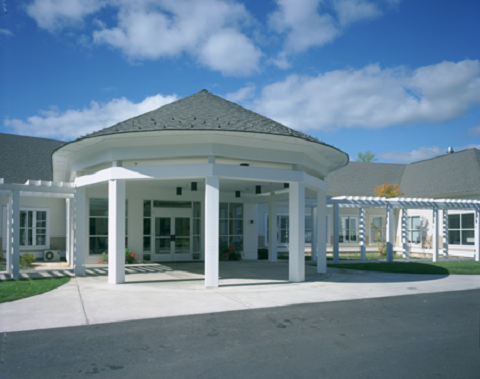
St. Vincent’s Medical Center Behavioral Health Inpatient Services, 2025