
Sigmund Freud
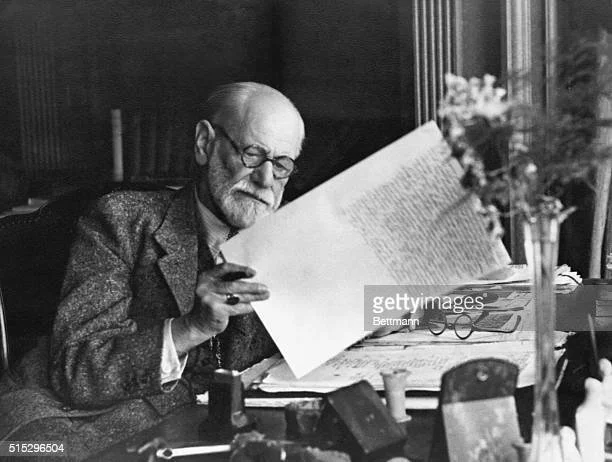
As you may know, or will come to know, Sigmund Freud, was an Austrian neurologist and founder of psychoanalysis, a clinical method of psychotherapy that seeks to uncover and interpret unconscious desires, thoughts and motivations that influence a person’s behavior and mental health. It is a complex and long term therapy approach requiring significant commitment from both the patient and therapist.
Sigmund Freud’s iconic analytic couch was a gift from one of his wealthy and grateful Viennese patients named Madame Benvenisti during the 1890’s while Freud practiced in Vienna. The plain, beige, divan-style sofa, or daybed, was reportedly gifted to Freud because Benvenisti found Freud’s furniture uncomfortable to sit in. She is believed to have said, “If I have to have my head examined, I want to be comfortable.” Freud eventually came to adorn the plain, wooden couch with Oriental and Persian rugs as well as velvet pillows but its primary covering was an elaborate Iranian Qashqa’i carpet he’d acquired through his brother-in-law Moritz Freud, a dealer in Berlin. Carpets of this sort were generally prepared for weddings, funerals, prayer and the birth of a son. Freud took to these efforts to enhance patient comfort. Today the couch remains an iconic object associated with psychoanalysis.
In 1938 Freud, along with his family and personal physician Max Schur fled Vienna to escape Nazi occupation and took his couch and rug along with him, having them crated and shipped to London, his new home and where they sit today on display in the Freud Museum, 20 Maresfield Gardens, London, NW3 5SX. The original birthplace of psychoanalysis however was in Vienna where Freud lived and worked for 47 years. It too is now a museum, located at Berggasse 19, A-1090 Wien, Vienna, Austria. Freud died just a year later on September 23, 1939.

Freudian Quotes

“Unexpressed emotions will never die. They are buried alive and will come forth later in uglier ways.”
“The only person with whom you have to compare yourself is you in the past.”
“If youth knew, if age could.”
“Before you diagnose yourself with depression or low self-esteem, first make sure that you are not, in fact, just surrounded by unpleasant people.”
“Most people do not really want freedom, because freedom involves responsibility, and most people are frightened of responsibility.”
“From error to error, one discovers the entire truth.”